
Car Catalytic Converter: What It Is and How It Works
Car Catalytic Converter: What It Is and How It Works
For some time now, great attention has been paid to the problem of air pollution: that’s why the car catalytic converter was invented years ago. Here’s how it works.
Car Catalytic Converter: What Is It?
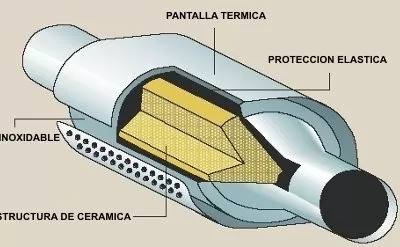
Car Catalytic Converter
The problem of air pollution is addressed by both governments and car manufacturers: to this day, all cars are equipped with devices created to limit all negative and polluting effects resulting from combustion as much as possible.
Modern catalytic converters are devices specifically designed to reduce pollutant emissions of CO, VOC, and NOx: to achieve this goal, they include a reduction system and an oxidation system, both formed by a ceramic structure that is, in turn, coated with a metal piece (platinum, rhodium, and/or palladium).
The catalytic converter is, therefore, one of the main elements that allow for the reduction of vehicle emissions, which is usually installed inside the muffler: visually, in fact, it appears as a bulge in the exhaust manifold.
Car Catalytic Converter: How It Works
The car catalytic converter, also called a catalytic converter, is an element of the exhaust system that cannot be dispensed with to ensure maximum reduction of the toxicity of gases. To do this, it recovers nitrogen oxides and uses oxygen for the post-combustion of carbon monoxide and unburned hydrocarbons.
To understand how a catalytic converter works, it’s good to know, at least broadly, what a catalytic process is, that is, a chemical reaction accelerated by a specific chemical element (the catalyst, actually).
Over time and with use, the car catalytic converter can lose its effectiveness and, therefore, its reaction may be slower, which invalidates its role of "purifying" the exhaust gases from pollutants.
Types of Catalytic Converters for Automobiles
There is not just one type of catalytic converter: there are catalytic modules designed to be added to the exhaust system and the classic catalytic converters (exhaust manifolds with a catalyst).
The main differentiation is based on the operation that varies according to the fuel used:
diesel: reducing action that converts NOx into nitrogen and oxygen
gasoline – oxidizing action with palladium-based converters (two-way or bivalent, but also three-way)
Some catalytic converters also use a Lambda sensor to determine the amount of oxygen and unburned fuel in the exhaust gases and maintain an optimal operating speed.
```